
Every parent wants the best for their child. We want them to grow into confident, happy, emotionally strong human beings. But in the journey of parenting, many of us feel confused, overwhelmed, or unsure about how to guide our children without yelling, punishing, or losing our temper.
Table of Contents
This is where Gentle Parenting comes in—a parenting approach that is becoming incredibly popular around the world. But what exactly is Gentle Parenting? Is it too soft? Does it mean children get whatever they want?
In this comprehensive beginner-friendly guide, you’ll learn what Gentle Parenting really is, why it works, how to start it, and common mistakes to avoid. By the end, you’ll have a clear understanding and practical steps to begin your Gentle Parenting journey today.
What is Gentle Parenting?
Gentle Parenting is a style of parenting based on four core elements:
➡️ Empathy
➡️ Respect
➡️ Understanding
➡️ Boundaries
Instead of controlling children through fear, punishments, shouting, or bribes, Gentle Parenting encourages building a strong parent-child connection. It focuses on guiding children rather than controlling them.
In simple words:
Gentle Parenting means teaching with love, not fear.
It empowers children to learn self-control, responsibility, emotional awareness, and respect—not because they are scared, but because they understand.
Key Idea
Gentle Parenting believes that every behavior is communication. So instead of reacting with anger, a parent tries to understand what the behavior is trying to express.
For example:
If a child is throwing a tantrum at the store, instead of yelling:
❌ “Stop it right now! You’re embarrassing me!”
A gentle parent might say:
✔️ “I know you really want that toy and you’re upset. I’m here. Let’s take a breath together.”
This response teaches emotional regulation and connection.
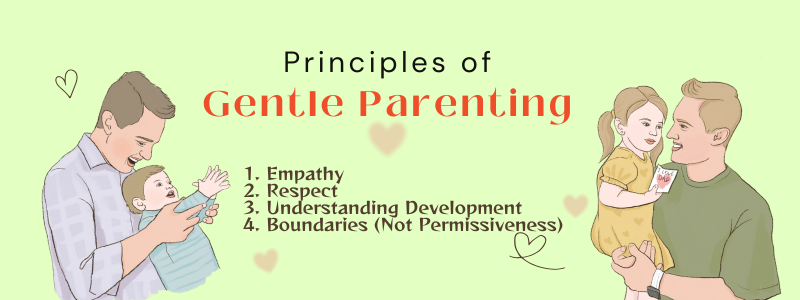
Principles of Gentle Parenting
Let’s break down the four major pillars of Gentle Parenting:
1. Empathy
Children have big feelings. Their brains are still developing emotional control. Gentle parenting understands this and responds to emotions with empathy rather than frustration.
Example:
“You’re frustrated because your tower fell. It’s okay to feel upset. Want help building it again?”
This shows the child their feelings matter.
2. Respect
Respect does not mean giving children everything they want—it means treating them like humans with thoughts and emotions.
❌ Respect is NOT letting them run wild.
✔️ Respect IS talking to them calmly and listening.
Example:
Instead of forcing a child to hug someone, you ask:
“Do you want to wave or give me a hug? You get to choose.”
3. Understanding Development
Gentle Parenting is grounded in child psychology. It acknowledges that:
- Toddlers can’t share easily — it’s developmental, not defiance.
- Young kids can’t regulate emotions yet — they need guidance.
- Teens seek identity — conflict is part of growth.
A gentle parent asks:
“What is my child developmentally capable of?”
before expecting perfection.
4. Boundaries (Not Permissiveness)
A big misconception is that Gentle Parenting is “too soft.”
But healthy boundaries are a major part of it.
Examples of gentle boundaries:
- “It’s okay to be angry. It’s not okay to hit.”
- “We can talk about this, but I will not yell at you and you will not yell at me.”
- “Screen time is over for today. We can watch more tomorrow.”
Boundaries create a sense of safety and structure.
Gentle Parenting vs Traditional Parenting
To understand Gentle Parenting better, let’s compare it with the most common parenting style many of us grew up with:
| Traditional Parenting | Gentle Parenting |
|---|---|
| “Because I said so!” | “Let me explain why this rule exists.” |
| Focus on obedience | Focus on understanding & cooperation |
| Uses punishment for bad behavior | Uses guidance & teaching |
| Parent always knows best | Parent and child learn together |
| Kids should be seen, not heard | Kids’ voices are respected |

Major difference:
Traditional parenting often demands obedience.
Gentle Parenting builds connection and cooperation.
Why Gentle Parenting Works (Scientifically and Emotionally)
Children’s brains do not respond well to fear-based methods. When a child is yelled at, their brain releases stress hormones like cortisol, which blocks learning.
Gentle Parenting supports brain development by:
- Strengthening emotional regulation
- Improving communication pathways
- Building trust and secure attachment
Long-Term Benefits
✔️ Higher emotional intelligence
✔️ Better problem-solving skills
✔️ Strong self-esteem
✔️ Healthy communication habits
✔️ Less anxiety and shame
✔️ Stronger parent-child relationship
Children learn:
- Not to hide feelings, but manage them
- Not to fear mistakes, but learn from them
- Not to obey blindly, but cooperate respectfully
Is Gentle Parenting the Same as Permissive Parenting?
No. This is the most common misunderstanding.
🚫 Permissive parenting = no rules, no boundaries, child leads everything
✔️ Gentle Parenting = loving boundaries + empathy + guidance
Gentle Parenting has firm boundaries, but they are enforced calmly, not aggressively.
Example difference:
Permissive:
“You don’t want to brush teeth? Okay, fine.”
Gentle:
“Brushing teeth is not a choice. You can choose the brush or the toothpaste flavor.”
Result:
The child still brushes, but with dignity.
How to Start Gentle Parenting (Beginner Steps)
Here are practical steps to implement Gentle Parenting:
1. Pause Before Reacting
When you’re triggered, take 5 seconds.
Your reaction teaches your child how to respond to stress.
2. Validate Feelings
Replace:
❌ “Stop crying! That’s nothing to cry about!”
With:
✔️ “Your feelings are real. I’m here when you’re ready.”
3. Offer Limited Choices
Choices reduce power struggles.
Examples:
- “Red cup or blue cup?”
- “Shoes on first or backpack first?”
- “Walk or skip to the car?”
4. Use Natural Consequences
Instead of punishment, let reality teach.
❌ Punishment:
“You spilled water. No TV tonight!”
✔️ Natural consequence:
“You spilled water. Let’s clean it together.”
5. Teach Emotional Vocabulary
Kids act out when they don’t know how to express feelings.
Teach words: frustrated, nervous, overwhelmed, excited, disappointed, confused.
6. Repair After Conflict
If you yell, apologize.
This is powerful modeling.
“I’m sorry I raised my voice. I was frustrated, but that’s not an excuse. I’ll try again. Let’s work together.”
Children learn accountability—not shame.
Real-Life Scenarios & Gentle Responses
Tantrums
Instead of:
❌ “Stop it or I’ll leave you here!”
Try:
✔️ “You’re having a hard time. I’ll stay with you until you feel better.”
Not Sharing
❌ “Share right now or time-out!”
✔️ “You can play with it until you’re done. When you finish, it will be your friend’s turn.”
Backtalk
❌ “You can’t talk to me like that”
✔️ “You can disagree, but we speak with respect. Let’s try again.”
Common Myths About Gentle Parenting
| Myth | Truth |
|---|---|
| Kids become spoiled | Actually builds responsibility & independence |
| No discipline involved | Uses guidance, not punishment |
| Only works for calm kids | Works for all kids with consistency |
| Parents must suppress anger | Parents learn healthy emotional expression |
| Takes too much time | Saves time in long-term by reducing power struggles |
Mistakes New Gentle Parents Make
Even well-meaning parents can struggle. Here are things to avoid:
❌ Confusing kindness with lack of boundaries
❌ Expecting instant results
❌ Trying to stay calm without self-regulation tools
❌ Assuming communication alone changes behavior
❌ Feeling guilty for past mistakes
Important Reminder
Gentle Parenting is a journey—not a test you pass or fail.
You WILL make mistakes. That’s okay. Repair matters more than perfection.
How Gentle Parenting Helps Parents Too
Gentle Parenting isn’t only for children—it heals parents.
- It breaks cycles of yelling and shame
- Encourages self-reflection
- Helps regulate emotions
- Strengthens communication skills
- Improves confidence as a parent
Many parents say Gentle Parenting helps them become:
💛 calmer
💛 more patient
💛 more connected to their child
💛 more healed from their own childhood wounds
Final Thoughts
Gentle Parenting is not about being a perfect parent.
It’s about showing up with love, boundaries, respect, and patience.
It’s about raising children who feel seen, heard, and valued—children who become adults with emotional strength and empathy.
If you’re starting today, remember:
✨ You don’t need to change everything at once
✨ Start with awareness
✨ One gentle choice at a time
Your child doesn’t need a perfect parent…
they need a connected one.